
The International Economic Association (IEA) has launched a multi-year global initiative to strengthen the presence and influence of women in the economics profession.
Through research, collaboration, and advocacy, the initiative seeks to identify and remove barriers to women’s participation — and to amplify the voices of women economists in shaping global economic discourse.
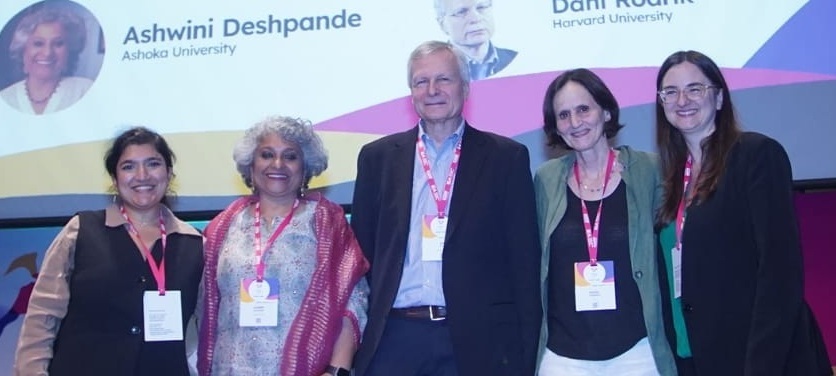
Led by Ashwini Deshpande (Ashoka University), with María Inés Berniell (Universidad Nacional de la Plata and CEDLAS), Raquel Fernández (New York University), Dani Rodrik (Harvard University), and Fiona Tregenna (University of Johannesburg), the initiative brings together leading scholars committed to advancing equity and excellence in the field.
We gratefully acknowledge the support of the Co-Impact Foundation and the Open Society Foundation, whose funding has made this initiative possible.
Why This Matters
Economics shapes how we understand governments, markets, and public policy — yet women remain underrepresented, especially in leadership roles. These disparities deepen when viewed through the lens of race, ethnicity, and geography.
IEA-WE addresses this challenge by promoting leadership among women economists globally.
Greater inclusion is not only a matter of fairness, it strengthens the discipline itself.
Diverse perspectives lead to richer analyses, more innovative solutions, and ultimately, better-functioning societies.
We recognize that progress requires both expanding the pipeline of qualified women economists and dismantling structural barriers that hinder advancement.
Women from developing countries often face a double disadvantage — by gender and geography — which is why our approach is intersectional, examining how gender intersects with race, caste, and region to create patterns of multiple disadvantage.
Our Work
1. Building the Evidence Base
Our research spans Latin America, Africa, and Asia, and focuses on:
- Collecting and synthesizing data on gender gaps in the economics profession
- Conducting cross-national surveys to understand experiences and barriers
- Evaluating “what works” — interventions that successfully reduce gender inequality
Read our completed evidence papers here.

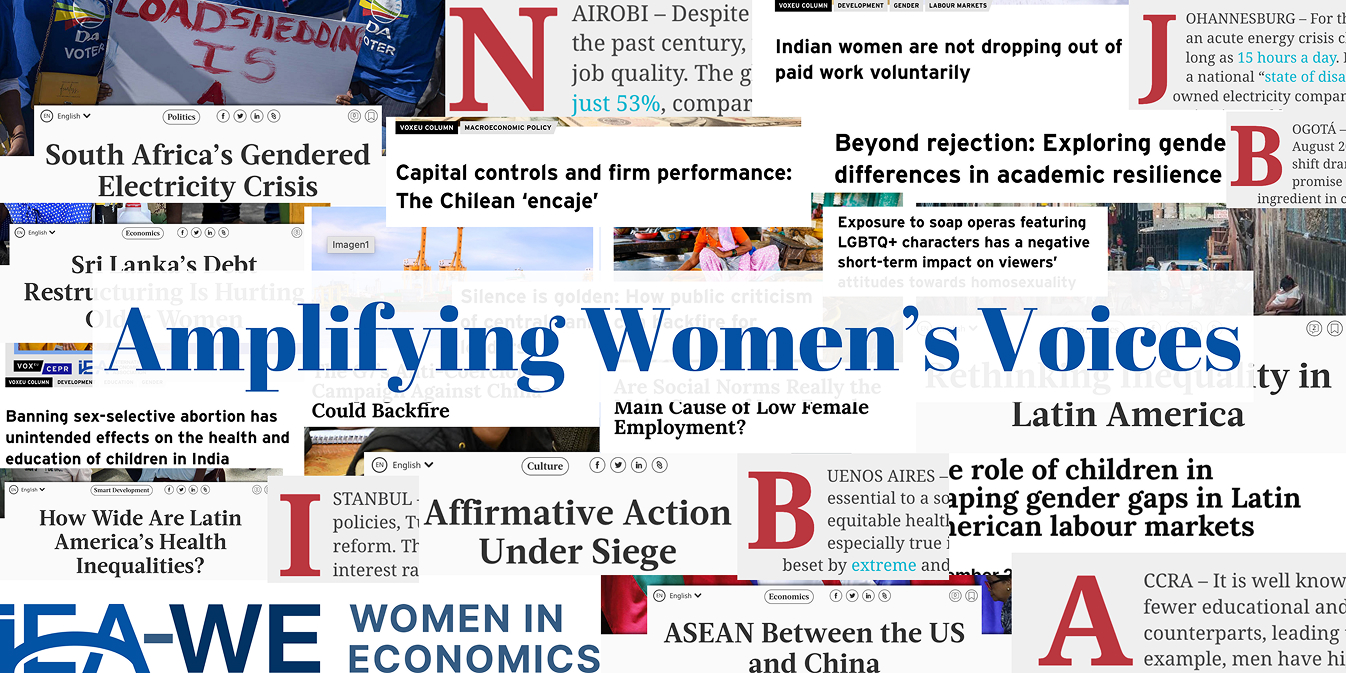
2. Amplifying Women Economists’ Voices
Visibility drives influence — and we are working to ensure women economists are heard in global policy conversations.
Through the Amplifying Voices Project, we have:
-
Partnered with major platforms including Project Syndicate, VoxEU, VoxDev, and IMF Finance & Development to shape global economic discourse
-
Collaborated with women economists from 27 countries across Africa, Asia, and Latin America to translate academic research into accessible policy articles, toolkits, and podcasts
-
Facilitated the publication of over 80 policy-relevant articles, elevating research on gender, digital finance, labor markets, climate, and governance
-
Strengthened networks of women economists across regions
-
Launched two podcasts — Driving Change (with IMF) and Econ-on-Mics (with Women in Economics & Policy) — expanding IEA’s global audience
-
Featured leading economists in the IEA’s Featured Economist of the Month series
-
Mentored early-career scholars to promote inclusive representation in economic policymaking
Read more and explore articles from the Amplifying Voices project here.
3. Building Synergies and Fostering Institutional Change
We engage with professional associations and like-minded organizations to strengthen networks, align goals, and promote lasting institutional reform within the economics community.

Team members
Ashwini Deshpande
Ashoka University
María Inés Berniell
Universidad Nacional de la Plata and CEDLAS
Raquel Fernández
New York University
Dani Rodrik
Harvard University
Fiona Tregenna
University of Johannesburg
Navika Mehta
Strategic Communications and Research Dissemination Lead, IEA-WE
Advisory Group
Radhika Balakrishnan
Rutgers University
Marianne Bertrand
University of Chicago Booth School of Business
Wendy Carlin
University College London, CEPR and Santa Fe Institute
Marcela Eslava
Universidad de los Andes
Rohini Pande
Yale University
Leonard Wantchekon
Princeton University
Launch event
What Economics Is Missing
March 22, 2023 – 3:00 pm CET
Speakers:
Ashwini Deshpande (Ashoka University)
Raquel Fernández (NYU and WELAC)
Dani Rodrik (Harvard University)
Minouche Shafik (LSE)
Vera Songwe (United Nations)
While economic research and policymaking play an increasingly central role in a globalized world, the discipline has been slow to reach gender parity — leading to blind spots and poorer decision-making across many domains.
What Economics Is Missing marked the launch of the IEA Women in Leadership in Economics Initiative (IEA-WE)— a global effort to ensure women’s insights and leadership are integral to shaping the future of economics.
We will be posting periodic project updates here. Visit this page/section for regular updates on the project.