
CORE
The CORE project creates free online economics textbooks and teaching resources used by over 165,000 students in over 500 universities around the world. CORE’s mission is to make economics teaching more engaging, accessible and rooted in real world issues that our students care about.
“This is quite simply the best economics textbook on the market. Unlike most others, The Economy teaches both the tools of the discipline and the way real economies work, making it useful and fun at the same time.”
Dani Rodrik, Professor of International Political Economy, Harvard University
CORE publications
CORE’s library is constantly expanding as worldwide interest in the project continues to grow.
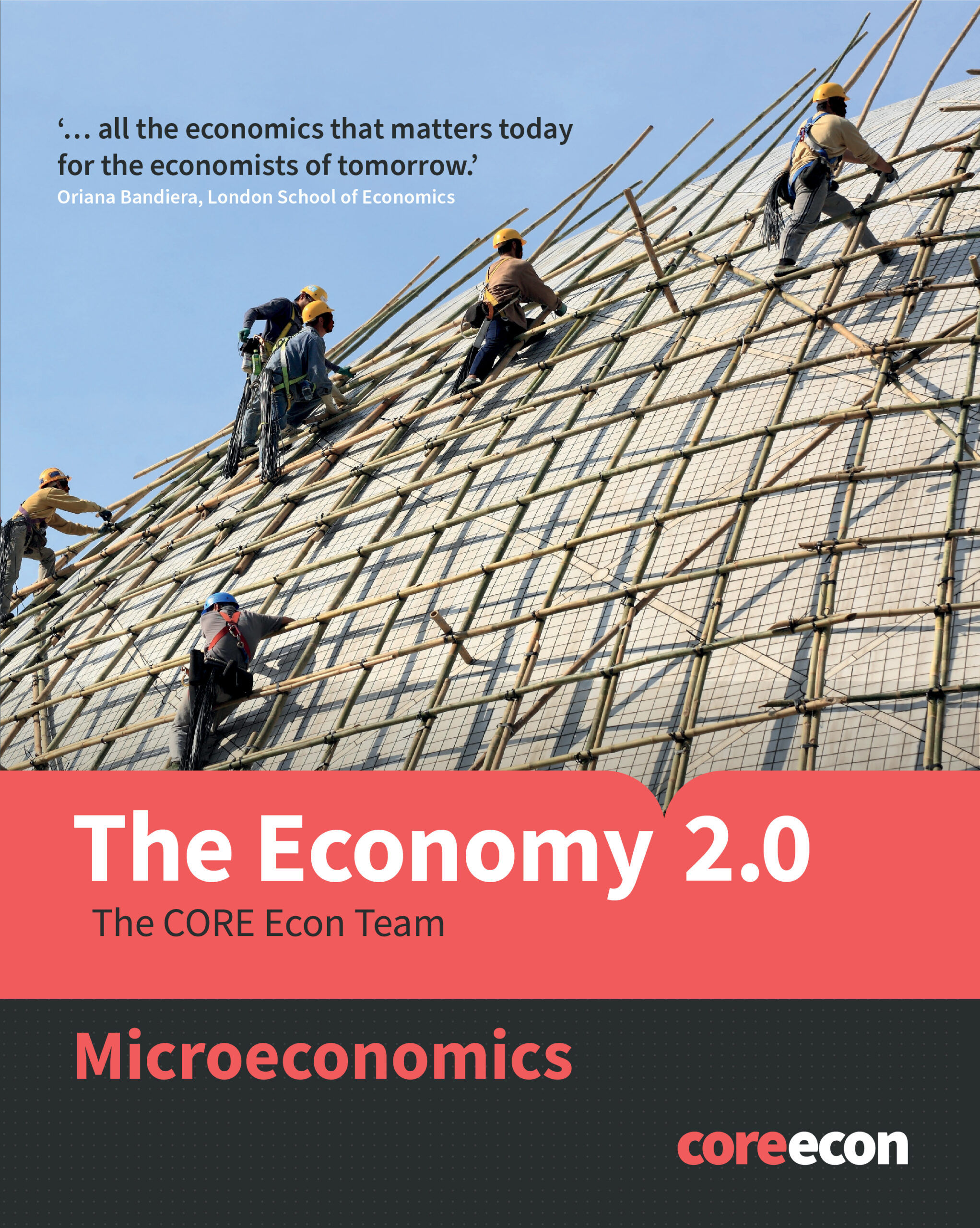
- The Economy 1.0, available in English, French, Italian, Spanish, Finnish, and Portuguese.
- The Economy 2.0: Microeconomics, available in English and Spanish. Forthcoming in Chinese and Korean.
- The Economy 2.0: Macroeconomics, available in English, forthcoming in Chinese, Korean and Spanish.
- Economy, Society, and Public Policy.
- Doing Economics, a collection of 12 empirical projects linked to themes in The Economy and Economy, Society, and Public Policy, to help students develop a wide array of data-handling skills.
- Experiencing Economics, a collection of games and experiments that instructors can play with their students in the classroom or online.
- CORE Insights, a self-contained educational resource that provides additional teaching and learning resources linked to relevant conceptual treatments in CORE’s ebooks.
- CORE Insights from the Global South, a series of insights that illuminate critical issues facing low and middle income countries, with a focus on a specific set of policy concerns.
- The Economy: A South Asian Perspective, an adaptation of The Economy which uses the style, framing and content of the original ebook and introduces topics and features specific to South Asian and developing economies.
Find out more about CORE’s ebooks.
How does CORE make economics more engaging?
What would an Intro to Economics course be like if you started with the problems that students think should be addressed most? Since the start of the CORE project we have run a yearly experiment. On the first day of their first class in economics we ask students: ‘What is the most pressing problem that economists should address?’ The resulting word clouds show the students’ responses.
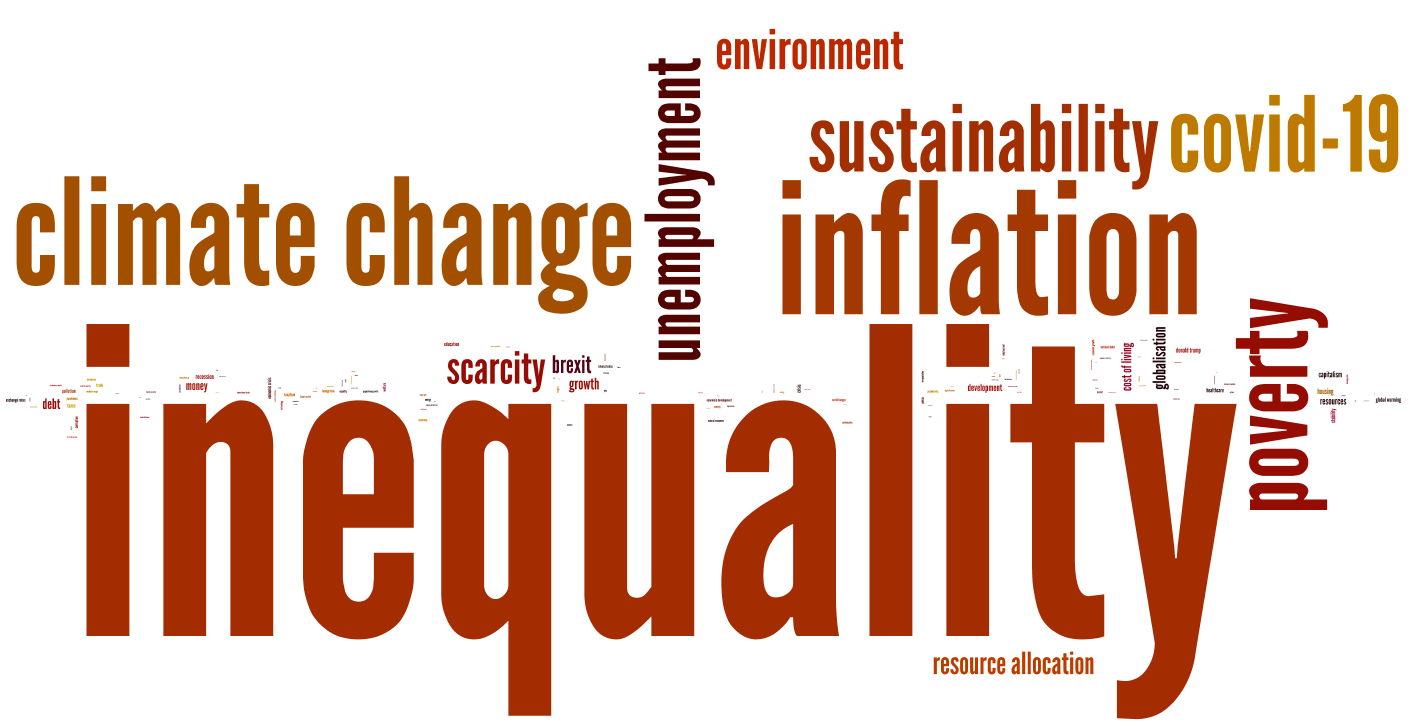
The figure above shows the responses of 14,784 students in 89 universities in 29 countries, collected between 2016 and 2024. Inequality has been consistently noted as the most pressing issue. In addition, students included climate change, inflation, sustainability and poverty in their answers.
By incorporating our students’ concerns into our materials, we ensure CORE remains relevant and engaging for future generations of economists.
“The CORE Project is the best innovation in economic education that I have seen in my career.”
Christian Gollier, former director, Toulouse School of Economics
CORE student and teacher resources
Students can access a range of interactive elements to support their learning, such as:
- interactive diagrams and online quizzes with feedback.
- an interactive visualisation to explore how the income distribution within and between countries has changed over time (1980-2014).
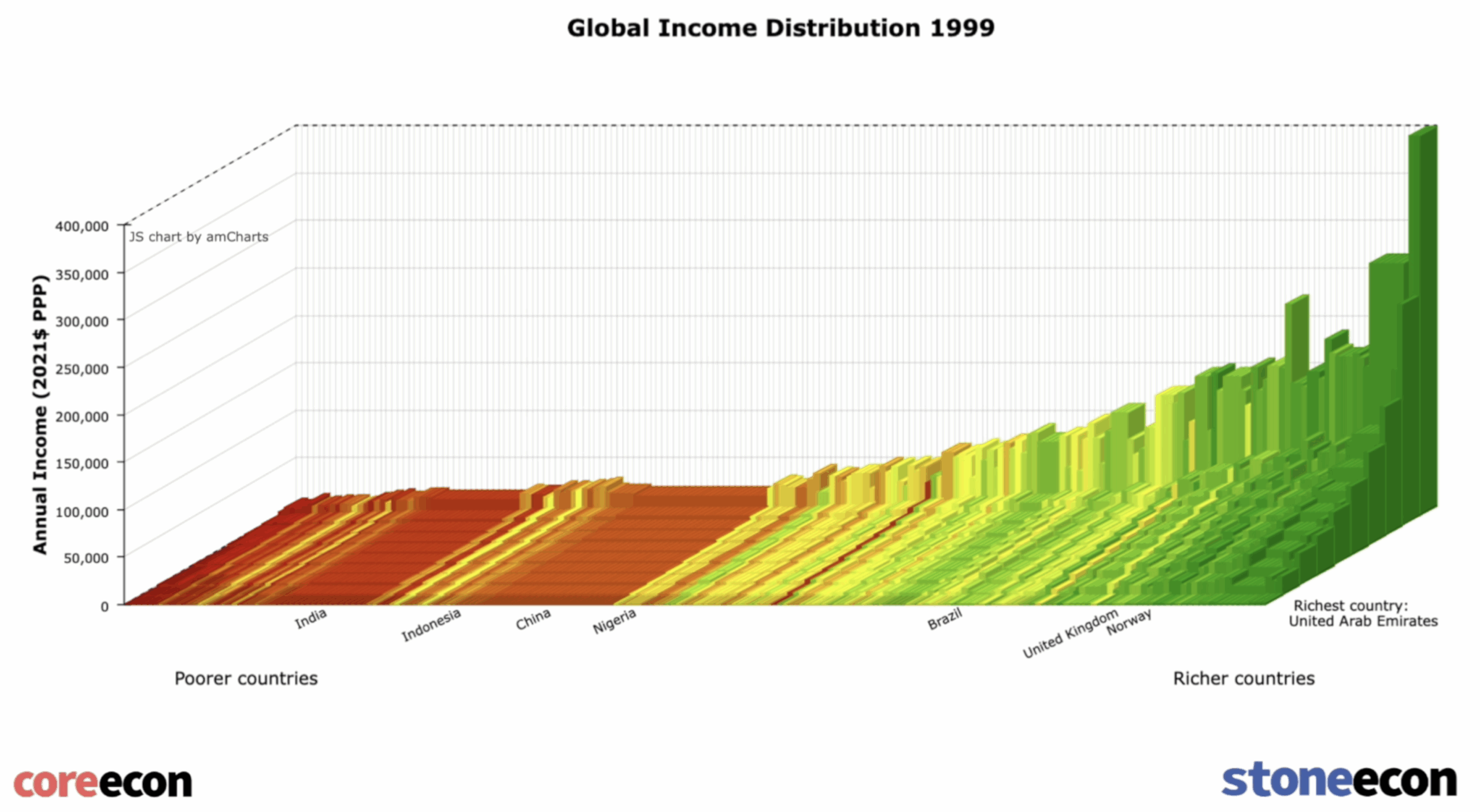
- an interactive visualisation demonstrating the effects of a household income shock on the income distribution of a country.

- an interactive inflation tool to help students understand what causes inflation and how policymakers can attempt to control it.

- Measuring economic inequality in today’s world, CORE’s free, online course providing learners with a historical overview of economic inequality over the past millennium, and introducing them to quantitative tools to measure it with real-world data. The course also explores issues of inequality in health and education, and its measurement.
Instructors have access to a range of resources to help them build a course:
- Lecture slides,
- Teaching guides for classroom and asynchronous teaching,
- Answers to exercises,
- A Question Test Bank with 1,000 questions with immediate feedback,
- Video tutorials covering key models in The Economy and Economy, Society, and Public Policy,
- Economist and Financial Times articles mapped to units of The Economy and Economy, Society, and Public Policy, with discussion questions,
- For data figures, instructors can download all the data sets used in the ebooks.
Economist in Action videos
CORE is supported by world renowned economists, many of whom have contributed to the Economist in Action series. In these videos, economists explain how their research helps to address a specific question that is discussed in CORE’s texts.
Watch Nobel laureate Simon Johnson’s Economist in Action video here.
View CORE’s Economist in Action playlist on YouTube.
Student outcomes
Research shows students taught using CORE perform better in all subjects.
“Testing a new approach to teaching introductory economics: Effects on subsequent learning“, was recently published in Southern Economic Journal. The paper shows that students who took an introductory economics subject taught from CORE’s The Economy went on to perform better in all subjects compared to students taught with other texts. The paper was written by Buly A. Cardak, Sue O’Keefe, Yen Dan Tong, and David Walker of La Trobe University.
Watch Buly explain the paper’s key findings below.
The background to CORE
In a series of articles, CORE’s leadership articulated the changing paradigm it is spearheading in the content of economics education and new pedagogy:
- What students learn in economics 101: Time for a change – a paper by Sam Bowles and Wendy Carlin, published in the March issue of the Journal of Economic Literature, which uses machine learning text analysis to uncover the evolution of introductory economics since Samuelson revolutionized intro in 1948, and sets out how CORE is attempting something similar to what Samuelson did in 1948 to address the new challenges that face us today.
- Another ‘Samuelson, 1948’ moment’? Evidence from machine learning – by using topic modelling, Wendy and Sam find that concepts empowering economists to address today’s major challenges – climate change, inequality and the future of work and of property rights in the knowledge-based economy – are missing from leading textbooks.
- In the Spring 2021 issue of IMF’s Finance & Development, Wendy and Sam reflect on the historical evolution and current state of today’s economic benchmark, crystallised in its assumptions of amoral and self-interested individuals, interacting in competitive markets governed by complete contracts.
CORE in the news
CORE’s The Economy used as reference in ChatGPT discussion paper
ChatGPT as Economics Tutor: Capabilities and Limitations used CORE’s assesses the ability of ChatGPT to explain economic concepts and answer multiple-choice questions. The paper was authored by Natalie Bröse, Christian Spielmann, and Christian Tode from the University of Bristol. CORE’s The Economy 1.0 was used as reference material to determine the accuracy of GPT-3.5, GPT-4o, and o1preview. The paper explains the decision to use CORE’s text on page 6 and how this choice impacts results on page 28. Read the paper here.
CORE’s The Economy used to develop AI learning assistant in India
Motivated by India’s caste‑based inequalities—especially disparities in English fluency and academic confidence—Tamo Halder, Assistant Professor at Azim Premji University, set out to develop an AI tool which prompts students as they encounter errors in coding or unfamiliar vocabulary using CORE’s The Economy as his base text. Read The Stone Centre’s interview with Tamo about his work.
CORE praised in The Atlantic
The CORE project was praised by Harvard Professor Danielle Allen in an article for The Atlantic; America and its universities need a new social contract. Danielle highlighted CORE’s efforts to make the teaching of economics more relevant to present day economic realities. Read the article here.
Keep up to date with CORE developments by subscribing to the CORE newsletter, or visiting the CORE blog.
Find out more about CORE in our introductory videos: