
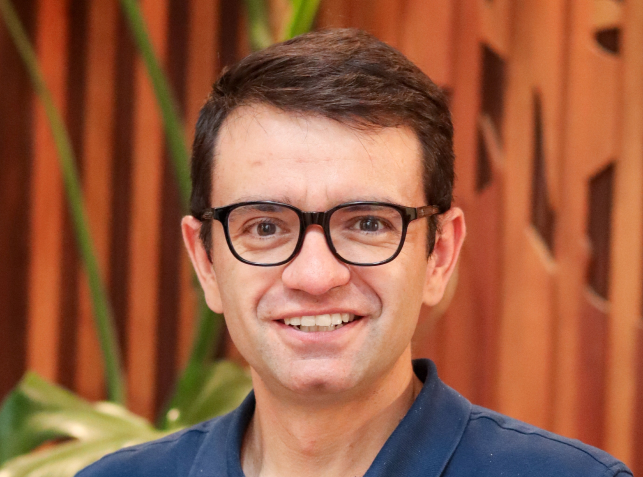
Santiago Saavedra
Santiago is Associate Professor and MPP Director at the School of Economics, of Universidad del Rosario in Bogotá, Colombia. He holds a PhD in Economics from Stanford University. His research focuses on the fields of Development and Environmental Economics. For example, topics of illegal mining, deforestation, air pollution and eco-tourism. Santiago uses spatial data, satellite imagery and machine learning to answer research questions. He was one of the winners of the Google Artificial Intelligence Impact Challenge
Follow Santiago on
Website
Follow Santiago on
Website
Santiago is Associate Professor and MPP Director at the School of Economics, of Universidad del Rosario in Bogotá, Colombia. He holds a PhD in Economics from Stanford University. His research focuses on the fields of Development and Environmental Economics. For example, topics of illegal mining, deforestation, air pollution and eco-tourism. Santiago uses spatial data, satellite imagery and machine learning to answer research questions. He was one of the winners of the Google Artificial Intelligence Impact Challenge
In their own words…
IEA – Could you walk us through the key moments that shaped your path, from your earliest exposure to economic thinking to what sparked your interest in the field, and ultimately what drew you to academic research?
Santiago – There are many moments that shaped my career. One of the first was in ninth grade, when I was planning to study aeronautical engineering. I realized that I was thinking in ten dimensions, but when you walk outside you see a lot of people living in poverty. That made me start wondering whether mathematical tools could be used to solve social challenges.
I also did not want to do a PhD until one day I went to a climbing wall and belayed a PhD student. At first, I thought, “Oh, it’s not that horrible—you just have to endure long exams and suffer a lot to get a title.” But then he told me that doing research as a PhD student is actually the best part, because you will never again have that level of freedom to explore any research question you want. If you are curious about a topic, that is the perfect opportunity.
That, combined with my passion for visiting national parks while growing up and participating in math Olympiads, made me realize that I could use my skills to address related social challenges.
IEA – In your work on Technology and State Capacity on Illegal Mining in Colombia, you test how improved monitoring tools and enforcement strategies affect extraction activity. What core insights emerged about the role of technology in strengthening state capacity and reducing environmental harm?
Santiago – The paper shows that when the government uses information from machine learning and satellite data, it can reduce illegal activity. The main result is an 11 percentage point reduction in illegal mining. A key insight is that this reduction comes mainly from the threat created by making information widely available. Authorities already knew that this activity was happening, but now miners know that someone else knows. This increases the likelihood of sanctions if enforcement agencies fail to act.
The second insight is that there are spillovers. Illegal activity decreases in targeted areas, but about half of it is displaced to other locations. This means enforcement needs to be a constant cat-and-mouse game rather than a one-time intervention.
IEA – Your research on eco-tourism and its conservation spillovers provides important evidence on how tourism-driven economic opportunities shape local environmental behavior. Based on your findings, what do you see as the principal constraints to ensuring that eco-tourism translates into sustained biodiversity protection, and how might policy design address these challenges?
Santiago – We find that eco-tourism promotion raises local employment by 16% and reduces deforestation by 52%. Local communities are often happy not to deforest, but many times they do so out of necessity. Someone else pays them to clear land, and they accept, because they need the income.
This result challenges the current dominant environmental policy approach, which focuses on preserving large natural areas without human presence.
Therefore, it is crucial to ensure a constant source of employment. From a policy perspective, this means guaranteeing that tourists actually arrive, which requires the provision of public goods such as security and infrastructure.
IEA – In another paper, you examine whether introducing air filtration technology in classrooms can improve students’ learning outcomes in environments with poor air quality. Could you summarise your key findings and their broader implications? What lessons does this provide for education policy in contexts where environmental conditions and institutional capacity constrain student performance?
Santiago – There is a large literature showing that pollution is harmful, but we need to move beyond that and ask what can be done about it. While many people would like to reduce pollution, current policy goals are often very slow. For example, in Bogotá the goal is to reduce pollution by 10% over ten years. Meanwhile, in Colombia we lose as many years of life to air pollution as to armed conflict.
Our idea was to install air purifiers in public facilities. We show that this intervention increases test scores. The magnitude of the improvement is equivalent to what major education reforms achieve over four years, but with just three months of clean air.
This shows that there are complementary policies that can improve student outcomes in the short run, even as longer-term efforts to reduce outdoor pollution continue.
IEA – How has your personal background influenced your research perspectives? What practical steps do you think the economics should take to become more inclusive and better reflect diverse global challenges?
Santiago – I love going to national parks, so I definitely care about solving the environmental challenges we face, as illustrated in the previous papers we discussed. I also care a lot about inequality, and I participated in math Olympiads as a child. When you look at a country like Colombia, where only 0.07% of public-school students participate in math Olympiads, you realize how much untapped talent exists. Some estimates suggest that research output could be 42% higher if students in developing countries had the same opportunities as their peers elsewhere.
In terms of practical steps, I think economists should follow their passions. If you simply follow the path of older generations and think strategically about what you need to achieve within the current system, you are unlikely to change that system. Finding a topic you are genuinely passionate about is essential, even if it differs from what is currently considered mainstream. I have sometimes been asked in seminars, “Why is this economics?”, because I work on environmental issues, but you should not be discouraged by those questions.
The second piece of advice is to communicate research in terms others understand. Sometimes people say, “I don’t care about protecting a tree,” but when you add the economic cost of environmental damage, it becomes a much more convincing argument.