
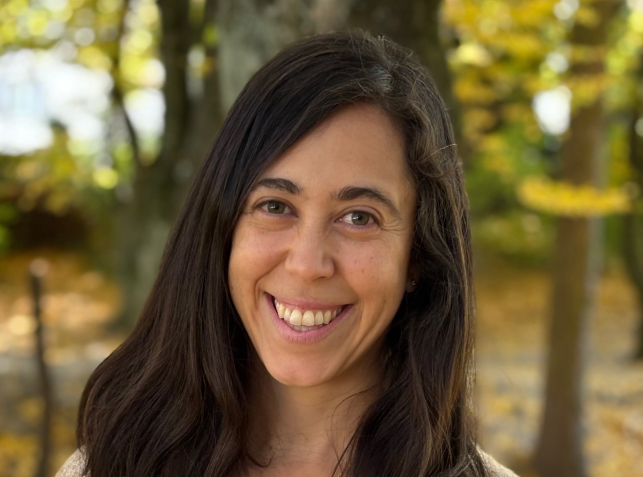
Fernanda Marquez Padilla
Fernanda Marquez-Padilla is an Associate Professor of Economics at El Colegio de México (COLMEX). She holds a PhD in Economics from Princeton University. Her research is in applied microeconomics, with a focus on health economics and development economics. Her work has been published in the Journal of Health Economics, Journal of Population Economics, The World Bank Economic Review, Economic Development and Cultural Change, and JAMA Pediatrics, among others, and has been covered by The Economist, Project Syndicate, VoxEU, and Freakonomics MD.
Follow Fernanda on
Website
Follow Fernanda on
Website
Fernanda Marquez-Padilla is an Associate Professor of Economics at El Colegio de México (COLMEX). She holds a PhD in Economics from Princeton University. Her research is in applied microeconomics, with a focus on health economics and development economics. Her work has been published in the Journal of Health Economics, Journal of Population Economics, The World Bank Economic Review, Economic Development and Cultural Change, and JAMA Pediatrics, among others, and has been covered by The Economist, Project Syndicate, VoxEU, and Freakonomics MD.
In their own words…
IEA – Could you walk us through the key moments that shaped your path — from your earliest exposure to economic thinking, to what sparked your interest in the field, and ultimately what drew you to academic research?
Fernanda – My earliest exposure to economic thinking came undoubtedly from my father, who was an economist and who, in many ways, thought like an economist. In retrospect, I realize that since I was a young child, I was directly and indirectly exposed to many of the key insights that are fundamental to economics, such as the role of incentives, competition, or efficiency. But there was also a huge emphasis on the importance of things like fairness, equality, and justice at home, which was also key in shaping my worldview and, eventually, my research interests.
Further down the line, I was genuinely uncertain about what to study in college — my interests were broad, and I was even seriously considering medical school. What I knew for sure was that I wanted to do something with social impact. A friend’s observation that economics doesn’t just teach you facts but gives you a powerful framework for thinking about almost any problem ended up being the nudge that led me to enroll in the economics program at ITAM, in Mexico City. Once I started with the undergraduate program, I loved economics from the start.
Years later, during my PhD at Princeton, a course on Health Economics was offered. I was immediately drawn to it. It felt like coming full circle to my earlier interest in medicine, and the intersection between health and development economics became the foundation of my research agenda. It is also where I met my brilliant advisor, Janet Currie, who is not only an amazing economist, but is also one of the most generous people I know, and who has shaped my career deeply.
IEA – Your research on Mexico’s Prospera program shows that switching rural women from cash to account deposits made it harder — not easier — to receive benefits. What does this tell us about the risks of digitizing cash transfer programs for vulnerable populations?
Fernanda – I think this project has two really important takeaways. The first is about time horizons. We could only observe the short-run effects of the transition, and those were largely negative—higher transaction costs, safety concerns, and incomplete transfers. But we couldn’t see the longer-run story, which might have looked different: women could eventually come to appreciate the convenience of ATM access, begin using other financial services, and banks might face new incentives to expand their presence in previously underserved areas. Digitization is not inherently problematic, but transitions often take time. If ignored, vulnerable populations end up bearing the costs of learning curves.
The second lesson is perhaps more fundamental: there are always obstacles that are often invisible when you are designing policy from behind a desk. This is true across many fields, but it is perhaps especially consequential for development economics, as the people affected often have less capacity to absorb the disruption. Understanding how policies actually work in practice, and not just in theory, requires getting much closer to the ground.
IEA – Your research finds that increased deforestation in Mexico is linked to lower birth weight and worse Apgar scores. What do you see as the main driver, and what does it mean for how we weigh the true costs of deforestation?
Fernanda – Our results point primarily to higher temperatures and increased pollution as the likely mechanisms: both are direct consequences of forest loss and both are known to affect fetal development during gestation. Negative health shocks during the gestational period are among the most consequential a person can experience, with effects on health and economic outcomes that can persist throughout a lifetime.
The broader implication is that the true costs of deforestation are likely to be underestimated when we focus only on what is directly and immediately visible—lost timber, reduced biodiversity, and carbon emissions. But the health costs to the next generation are real, they are measurable, and they should be part of any serious cost-benefit analysis of environmental policy. Making them visible is, I think, one of the most important contributions our research can make.
IEA – Your research shows menopause significantly reduces women’s employment and increases health risks, with hormone replacement therapy helping offset some effects. What does this suggest about how workplaces and health policy should adapt?
Fernanda – When my colleague Laura Juarez and I began this research, we were struck by how little rigorous evidence exists on the economics of menopause. It is all the more surprising, given that it is a transition that affects every woman and, by extension, a substantial share of the labor force at any given time. The gap in the literature is remarkable, especially as the economic costs of menopause are not only borne by women themselves: they have a broader societal cost, which also affects labor markets and households.
What we find, which is consistent with the findings in a growing body of research, is that women tend to be underserved during this transition, both by healthcare systems and by workplaces, and that improving the management of menopause can help mitigate the costs of the transition both in terms of labor and health outcomes. The use of hormone replacement therapy (HRT) stands out as an excellent option for managing symptoms for many women, as does improving timely diagnoses. Overall, healthcare provision during this phase can mitigate the observed “menopause penalty,” and it would seem that, although menopause itself is unavoidable, its costs are not.
One message I feel strongly about is that we need better data. Surveys on health, labor, and household welfare routinely fail to ask even the most basic questions about women’s menstrual cycles and their cessation. A handful of simple questions could unlock a great amount of knowledge. That is, to my mind, one of the most actionable and cost-effective things we could do right now.
IEA – How has your personal background influenced your research perspectives, and what concrete steps do you think the economics field should take to become more inclusive?
Fernanda – I have been very fortunate to spend much of my career doing research about my own country. That proximity makes the potential policy impact feel tangible in a way that is deeply motivating. I’ve also had the chance to work at two of the best economics departments in Mexico — El Colegio de México and CIDE — both public institutions that offer highly competitive programs to students from very diverse socioeconomic backgrounds. The result is a remarkable student body: I’ve had the privilege of teaching students who are highly talented, motivated, and hard-working.
I also realize that some of my research has been quietly shaped by my personal circumstances: living in a middle-income country, having children, approaching midlife. These are not abstract topics for me. I think that kind of lived proximity to the questions you study is an underrated source of insight. It is probably also one of the strongest arguments for why diversity in economics, in its broadest sense, matters not just as a matter of fairness, but of scientific breadth.