
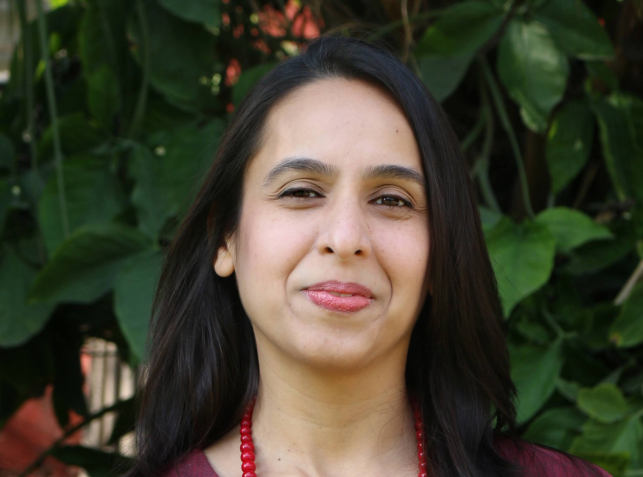
Hadia Majid
Hadia Majid is Associate Professor and Chair of Economics at Lahore University of Management Sciences (LUMS). Her research examines gender, labour markets, digital inclusion, and development in the Global South, with a particular focus on women’s work and economic opportunity in Pakistan. She works closely with policymakers and international organisations to translate research into evidence-based policy. Hadia holds a PhD in Development Economics from The Ohio State University.
Follow Hadia on
Website
Follow Hadia on
Website
Hadia Majid is Associate Professor and Chair of Economics at Lahore University of Management Sciences (LUMS). Her research examines gender, labour markets, digital inclusion, and development in the Global South, with a particular focus on women’s work and economic opportunity in Pakistan. She works closely with policymakers and international organisations to translate research into evidence-based policy. Hadia holds a PhD in Development Economics from The Ohio State University.
In their own words…
IEA – Could you walk us through the key moments that shaped your path – from your earliest exposure to economic thinking, to what sparked your interest in the field, and ultimately what drew you to academic research?
Hadia – My pursuit of a career in academia really began when I became involved in a research project led by one of my professors during the third year of my undergraduate economics degree. The project required student volunteers to conduct household-level survey work in rural Punjab, Pakistan, where we spent about two weeks in the field collecting detailed socio-demographic information alongside data on political participation and voting behavior. The experience allowed me to witness, firsthand, how the economic concepts and empirical tools I had encountered in the classroom could be used to understand real households and their decision-making under constraints. Engaging directly with households, and observing how economic conditions, social norms, and institutional realities shaped everyday choices, made the analytical frameworks of economics feel both tangible and urgently relevant.
Up to that point, I had assumed I would move into the corporate sector after graduation. However, the experience of fieldwork fundamentally reshaped my trajectory by revealing the intellectual excitement and social purpose of research. I became increasingly drawn to questions about inequality, livelihoods, and the ways policy interventions interact with lived realities. That early exposure to applied research not only sparked my interest in development economics but also convinced me that an academic path that combined rigorous analysis with field-grounded inquiry would allow me to contribute most meaningfully to understanding and addressing the economic challenges faced by vulnerable populations.
IEA – Based on your research with low-income women workers in Pakistan, how are women leveraging digital technologies to navigate patriarchal constraints around mobility and internet access? What were the most surprising barriers or enablers you discovered in your interviews across domestic, factory, and home-based work settings?
Hadia – Over the past four years, our research team surveyed and documented the experiences of roughly 250 low-income women across Pakistan to understand how digital technologies shape their ability to earn in a context marked by low female labor force participation and persistent gender gaps. Predictably, we found that the affordability of devices and data mattered for access and usage. However, the more binding constraints often lay in literacy and platform design, and social norms governing technology use. And while many low-literate women struggled with text-based interfaces, they also developed ingenious workarounds: relying heavily on voice features, video search, and assistance from family members to communicate with clients, learn new skills, and access information.
Among our surveyed women, digital platforms were widely used to expand existing livelihoods rather than create entirely new ones. Women watched short-form videos to track design trends, marketed products through social media marketplaces, and preferred women-only online spaces that reduced exposure to harassment and increased trust with customers. In some cases, access to one digital service, such as a mobile wallet, served as an entry point into broader online financial and commercial activity.
Yet, while we found stories of amazing grit, the interviews also revealed how deeply patriarchal controls continue to shape women’s digital lives. Phone ownership and visible use exposed women to monitoring, reputational risk, or accusations of impropriety, particularly for those commuting to work. Even among home-based workers, devices were commonly shared within households, and privacy features such as passwords often triggered suspicion and domestic conflict. As a result, some women remained reluctant to fully adopt digital financial tools despite recognizing their convenience, preferring physical transactions to retain control over their income.
Overall, the findings show that women are leveraging digital technologies in highly adaptive and creative ways to navigate mobility and market constraints. At the same time though, they also underscore that technology alone cannot overcome entrenched social norms. Designing effective digital inclusion policies therefore requires not only expanding access but also building platforms and programs that reflect shared-device realities, literacy barriers, and the social acceptability of women’s technology use.
IEA – Your study found that unconditional cash transfers helped women in Pakistan recover better from agricultural downturns, yet they still struggled to access non-agriculture income. What explains this paradox, and what does it suggest for improving cash transfer programs?
Hadia – The study did not directly examine this aspect but drawing on my other work, I can say that while the cash transfers helped women recover from agricultural downturns, the reason why the transfers did not translate into greater access to non-agricultural income opportunities is likely because the deeper structural barriers that shape women’s employment choices in Pakistan remained largely unchanged. This includes such factors as restricted mobility, gender norms governing acceptable work, limited sector-specific skills, and weak access to networks linking women to non-farm jobs. As a result, agriculture and related activities which were easy for women to access and were generally deemed “acceptable” modes of work for women, remained the primary fallback sectors for them.
The findings therefore suggest that unconditional transfers are effective as protective instruments but are not, on their own, sufficient to generate transformational shifts in women’s economic opportunities especially in contexts where the employment choice set for women remains constrained. To improve programme impact on economic outcomes then, transfers should be complemented by measures that directly address labour-market segmentation and gender-specific constraints. Such measures could include targeted skills training aligned with local non-farm demand, job placement or enterprise support, improved access to transport and childcare, and initiatives that strengthen women’s financial inclusion and professional networks. Hence, while my work shows that transfers play an important role in income smoothing and shock absorption, meaningful livelihood diversification requires integrated interventions designed to expand women’s feasible employment set rather than only stabilize household resources.
IEA – Your study found that women’s employment in Pakistan responded differently to growth than men’s, depending on gender-specific factors like education and life expectancy. Why did improved social status (measured by life expectancy) reduce women’s employment precarity, while educational parity increased their access to jobs?
Hadia – This paper highlights that women’s employment responses to growth are shaped by the interaction of macroeconomic conditions with the country’s gender order. Indeed, women’s employment in Pakistan does not respond to economic growth in the same way as men’s, because women’s labor market participation is shaped by deeper gendered social constraints.
In the paper, relative women’s life expectancy is used as a proxy for women’s social status: when women’s survival improves relative to men’s, it signals stronger household valuation of girls and better health and social conditions. Hence, when women’s social status rises, they are less likely to be pushed into distress-driven or highly vulnerable forms of work and are more able to withdraw from insecure employment during downturns. In other words, better status reduces the need for “added-worker” responses and stabilizes women’s labour supply rather than simply expanding it.
Educational parity operates through a different but complementary channel. Greater gender equality in schooling directly increases women’s ability to benefit from growth by expanding their skills and thereby improving their employability in sectors that grow with the economy. Hence, when educational gaps narrow, women are better positioned to translate macroeconomic expansion into actual employment opportunities.
Thus, the two indicators capture distinct channels: education improves women’s capacity to enter and compete in labor markets, while improved life expectancy reflects enhanced social valuation that reduces vulnerability and distress employment, leading to more secure rather than simply more numerous jobs. Together, the findings suggest that growth alone is not enough to improve women’s labour market outcomes: social investments that enhance women’s health and status help reduce precarious employment, while investments in girls’ education are crucial for enabling women to translate economic growth into meaningful and sustained access to jobs.
IEA – How has your personal background influenced your research perspectives, and what concrete steps do you think the economics field should take to become more inclusive?
Hadia – My research journey has closely mirrored my personal journey. It was around the time I became a mother that my work began to focus more intensively on women’s labour supply and the structural barriers shaping women’s economic participation in Pakistan. Experiencing firsthand the demands of balancing paid work with caregiving sharpened my awareness of how economic models often treat labour supply as a purely individual choice, while in reality it is deeply embedded in social expectations, time constraints, and identity. This perspective has informed my research on the intersection of productive and reproductive work, including recent work examining how women can experience a loss of identity when institutional structures force them to choose between income generation and caregiving responsibilities. Bringing lived experience into dialogue with empirical research has strengthened my commitment to studying labour markets not just as systems of incentives, but as social institutions that distribute opportunities and constraints unevenly.
For the economics profession to become more inclusive, we need both institutional flexibility and a deeper reckoning with the discipline’s structural barriers. Economics training, particularly in the North American PhD model, remains deeply rooted in STEM traditions, meaning that the well-documented obstacles women face in entering and persisting in STEM fields also shape who enters and advances in economics. Beyond entry, a growing body of evidence shows that women in the profession face systematic biases: they are interrupted more in seminars, excluded from influential networks and mentoring circles, and evaluated along professional norms and timelines that are documented to compete with reproductive burdens. These challenges are compounded for scholars working in the Global South, who often remain peripheral to major conference circuits, funding opportunities, and editorial networks, with journal processes often reinforcing existing gatekeeping structures.
Addressing inclusion therefore requires concrete steps such as flexible career timelines, stronger childcare and parental support, intentional mentoring structures, more equitable conference participation, and editorial practices that broaden whose questions and contexts count as central to the discipline. Without such changes, the discipline risks narrowing both who participates in the field and the kinds of realities it is able to effectively interrogate. Indeed, given the significance of economics within the social sciences and its influence on questions of major social and human importance, a failure to actively widen participation risks severely narrowing intellectual horizons and ultimately eroding the discipline’s relevance for policy and public life. A failure to inculcate effective inclusion, then, will result in a profound loss with implications that traverse a much larger landscape than the boundaries of the discipline itself.